


Cabinet fillers matter because they provide the clearance needed for cabinet doors, drawers, appliances, and hardware to function properly. These narrow finishing pieces also help cabinets fit against uneven walls, eliminate awkward gaps, and create a consistent appearance throughout the kitchen.
At Cincinnati Cabinets, we consider fillers an important part of cabinet planning rather than an unnecessary addition. When installing kitchen cabinets in Amelia, OH, we evaluate wall conditions, appliance placement, and door movement before determining where fillers are needed.
A filler that measures only one or two inches wide can prevent problems that would otherwise require significant cabinet modifications.
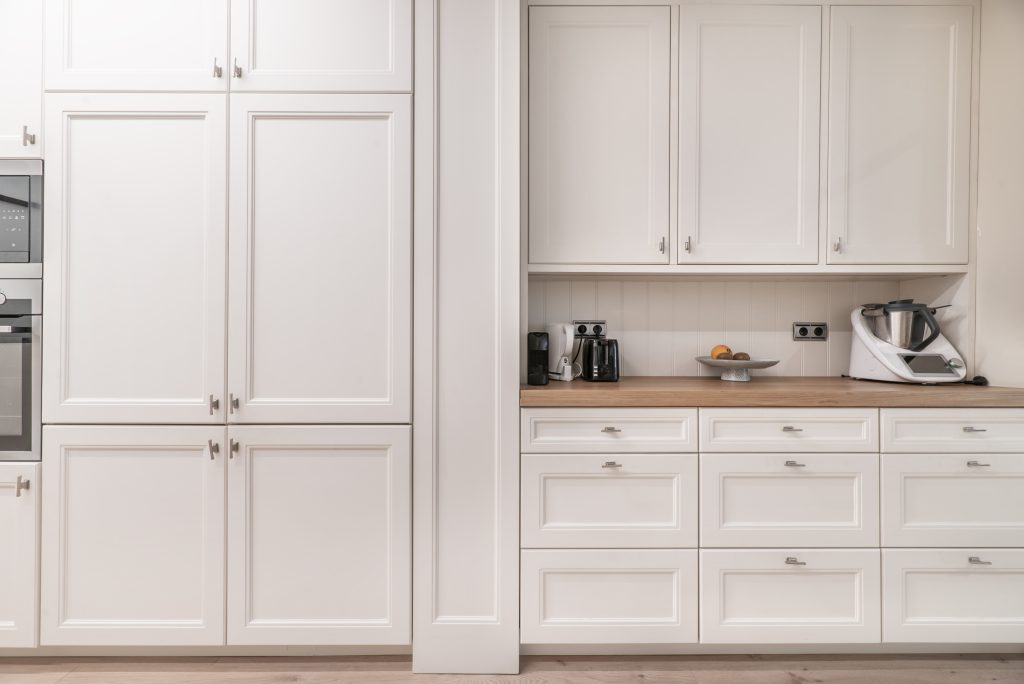
What Is a Cabinet Filler and What Does It Actually Do?
A cabinet filler is a narrow strip of material installed between cabinets, walls, appliances, or other fixed surfaces to provide clearance or create a finished transition.
Unlike a standard cabinet, a filler does not provide storage space. Its purpose is to make the surrounding cabinetry fit and operate correctly.
Fillers are commonly manufactured from painted wood, plywood, MDF, or material that matches the cabinet finish. Their widths vary depending on the installation requirements.
We typically use fillers in three situations: where cabinets meet walls, where two cabinet runs meet at a corner, and where appliances need additional clearance.
Without proper planning, a small gap can become a noticeable installation problem.
Why Can’t Kitchen Cabinets Always Be Installed Flush Against a Wall?
Cabinets cannot always sit directly against walls because walls are rarely perfectly straight, square, or plumb.
Even in relatively new homes, drywall variations and framing tolerances can affect how cabinetry fits. Older kitchens may have more pronounced irregularities.
For example, a wall might gradually move inward by half an inch along a cabinet run. Installing cabinets without accommodating that variation could leave uneven gaps or prevent the final cabinet from fitting.
When planning kitchen cabinets in Amelia, OH, we take measurements at multiple locations instead of relying on a single wall dimension.
A filler can be scribed, meaning its edge is carefully shaped to follow an irregular wall surface.
This allows the visible cabinet line to remain straight while the filler accommodates differences in the wall.
How Do Cabinet Fillers Prevent Doors and Drawers From Hitting Walls?
Cabinet fillers create space for doors, drawer fronts, handles, and hinges to move without contacting nearby walls or cabinetry.
This is especially important when a cabinet sits immediately beside a perpendicular wall.
Imagine a drawer cabinet installed tightly against a wall. The drawer box might technically fit, but its handle or front panel could hit the wall trim when opened.
A correctly sized filler shifts the cabinet away from the obstruction.
We also check hinge movement because some cabinet doors require additional clearance to open beyond 90 degrees.
How Wide Should a Cabinet Filler Be?
Cabinet fillers commonly measure approximately 1-3 inches wide, although narrower or wider pieces may be necessary depending on the layout.
A 1-inch filler might provide sufficient clearance for certain door configurations. A corner cabinet, appliance installation, or large decorative handle could require more.
We determine the final width using actual hardware dimensions, door swing requirements, and wall conditions.
The goal is to provide enough clearance without sacrificing more storage space than necessary.
Where Are Cabinet Fillers Most Important in a Kitchen?
Cabinet fillers are particularly important at corners, beside refrigerators, near walls, and around built-in appliances.
Each location presents different installation challenges.
| Location | Why a filler may be needed | Problem it helps prevent |
|---|---|---|
| Cabinet against a wall | Provides clearance for doors and hardware | Handles striking the wall |
| Inside kitchen corner | Separates intersecting cabinet fronts | Drawers or doors colliding |
| Beside refrigerator | Accommodates hinge movement and required spacing | Restricted refrigerator access |
| Near dishwasher | Helps align cabinets and maintain proper appliance opening | Interference with adjacent cabinetry |
| Between cabinet and uneven wall | Accommodates irregular surfaces | Visible gaps and poor alignment |
| End of cabinet run | Creates a finished transition | Exposed or unfinished edges |
At Cincinnati Cabinets, we review these locations before the cabinet layout is finalized.
We also consider the placement of baseboards, window casings, and decorative trim, which can sometimes interfere with cabinetry.
Do You Need Fillers Between Cabinets and Refrigerators?
Sometimes. Refrigerator fillers are useful when additional side clearance is necessary for door hinges, handles, ventilation, or proper cabinet alignment.
However, refrigerators have different installation requirements. We never assume that the same filler width works for every model.
A French-door refrigerator, for example, may require extra space beside a wall so its doors can open far enough to remove interior drawers.
When designing kitchen cabinets in Amelia, OH, we ask homeowners to confirm their refrigerator model before we finalize the surrounding cabinets.
We also distinguish between decorative fillers and manufacturer-required appliance clearances.
A filler can help establish the correct opening, but it cannot replace required ventilation space.
Are Cabinet Fillers Necessary in Kitchen Corners?
Yes, fillers are often necessary in kitchen corners because perpendicular doors, drawers, and handles can interfere with one another.
Consider an L-shaped kitchen with drawer cabinets positioned close to an inside corner.
Without adequate separation, opening one drawer could cause its front or handle to strike the cabinet on the adjoining wall.
Corner fillers help prevent these collisions.
We evaluate the direction of door swings and the projection of drawer handles before selecting the spacing.
In some layouts, changing the cabinet configuration may provide a better solution than installing a wider filler.
This is why corner planning should happen during the design stage rather than after cabinet installation begins.
What Materials Are Best for Cabinet Fillers?
Cabinet fillers should be made from materials compatible with the surrounding cabinetry and finished to match the visible cabinet surfaces.
Birch, plywood, and MDF are common choices, depending on cabinet construction and the desired finish.
| Material | Typical application | Main advantage | Maintenance considerations |
|---|---|---|---|
| Solid birch | Visible painted or stained fillers | Can coordinate with solid-wood cabinet components | Protect finish from moisture |
| Plywood | Cabinet-related structural and finishing components | Good dimensional stability | Seal exposed edges appropriately |
| MDF | Painted filler strips | Smooth painted surface | Avoid prolonged exposure to water |
| Finished decorative panels | Exposed ends and appliance surrounds | Consistent appearance with cabinet doors | Follow manufacturer cleaning recommendations |
For painted cabinetry, matching the color and sheen is particularly important.
A filler with a slightly different finish can become noticeable under kitchen lighting.
We also consider the filler material’s stability when installing it near appliances that produce heat or moisture.
How Do Cabinet Fillers Affect Countertop Installation?
Cabinet fillers help establish the final cabinet layout, which directly affects countertop measurements, overhangs, and alignment.
When a filler changes the position of a base cabinet, it also changes where the countertop must extend.
This matters for granite, quartz, and marble installations because these materials are fabricated according to specific dimensions.
For example, a two-inch filler installed between a base cabinet and a wall must be accounted for during countertop templating.
Ignoring that space could result in an incorrect countertop fit.
At Cincinnati Cabinets, we coordinate cabinet installation with countertop measurement and fabrication so the finished surfaces align properly.
Do Fillers Matter for Granite, Quartz, and Marble Countertops?
Yes. All three materials require accurate measurements and suitable support, regardless of the countertop’s appearance or maintenance requirements.
| Material | Heat resistance | Stain resistance | Maintenance |
|---|---|---|---|
| Granite | Generally good; thermal shock remains possible | Varies by stone and sealer | Some varieties require periodic sealing |
| Quartz | Heat exposure can damage resin components | Generally strong against household stains | Routine cleaning; no sealing |
| Marble | Naturally heat-resistant but susceptible to thermal shock | More prone to staining and acidic etching | Prompt spill cleanup and appropriate sealing |
Fillers themselves do not replace structural countertop support.
We assess whether additional support panels, brackets, or other reinforcement are necessary.
Backsplashes also require careful measurements, particularly where countertops meet irregular walls.
How Much Do Kitchen Cabinets and Fillers Cost?
Kitchen cabinet projects can be budgeted at approximately $300 per linear foot, with actual costs depending on materials, configuration, hardware, and installation requirements.
Cabinet fillers are generally priced as part of the overall cabinetry design or as additional components, depending on the project.
For homeowners comparing kitchen cabinets in Amelia, OH, the following figures provide basic planning examples.
| Cabinet length | Estimated budget at $300 per linear foot |
|---|---|
| 10 linear feet | $3,000 |
| 15 linear feet | $4,500 |
| 20 linear feet | $6,000 |
| 25 linear feet | $7,500 |
These figures are illustrative rather than fixed installation quotes.
Factors affecting the final price include cabinet construction, door style, filler materials, specialty storage, and the complexity of the kitchen layout.
Countertop fabrication, backsplash installation, and modifications to plumbing or electrical systems may involve separate charges.
We recommend discussing these details before approving the final project estimate.

How Long Does Cabinet Installation Take When Fillers Are Required?
A cabinet project may take approximately 3-5 weeks from approved planning through completion, depending on material availability, fabrication, and installation scheduling.
Cabinet fillers generally do not add significant time when they are included in the original design.
Problems are more likely when fillers are overlooked and must be added after the cabinets arrive.
Our typical process includes:
- Kitchen measurements: Check wall dimensions, corners, and existing obstructions.
- Layout planning: Determine cabinet positions and necessary filler widths.
- Material selection: Coordinate cabinet doors, fillers, panels, and finishes.
- Fabrication: Prepare cabinetry and matching finishing components.
- Installation: Secure and level cabinets, fit fillers, and verify clearances.
- Final checks: Confirm door operation, appliance access, and countertop alignment.
When installing kitchen cabinets in Amelia, OH, we prefer resolving spacing concerns before fabrication begins.
Frequently Asked Questions About Cabinet Fillers
1. Can You Install Kitchen Cabinets Without Fillers?
Yes, in some layouts. Fillers may be unnecessary when cabinets have sufficient clearance and surrounding walls are properly aligned.
2. Are Cabinet Fillers Usually One or Two Inches Wide?
Both widths are common. The correct measurement depends on door hardware, wall conditions, and the surrounding cabinet configuration.
3. Do Cabinet Fillers Waste Storage Space?
They occupy some space, but they help prevent interference that could make nearby cabinets difficult or impossible to use.
4. Can Cabinet Fillers Be Cut During Installation?
Yes. Many fillers are trimmed or scribed during installation to accommodate actual wall dimensions and irregularities.
5. Should Cabinet Fillers Match Cabinet Doors?
Yes, visible fillers should generally match the cabinetry’s color, finish, and overall appearance for a consistent result.
6. Are Fillers Necessary Around Dishwashers?
Not always. They may be needed for alignment or clearance, but dishwasher openings must follow the manufacturer’s installation requirements.
7. Can Cabinet Fillers Be Added After Installation?
Sometimes. However, adding them later can require moving cabinets, adjusting trim, or modifying adjacent countertop components.
Where Can You Get Help With Kitchen Cabinet Installation in Amelia, OH?
Cincinnati Cabinets is based in Cincinnati, OH, and serves homeowners in Amelia, OH, and surrounding communities. We help plan kitchen layouts that account for wall irregularities, appliance clearance, cabinet fillers, and efficient storage.
Our services include cabinet design and installation, material selection, and coordination of granite, quartz, and marble countertop fabrication and installation, as well as backsplash planning.
If you are considering kitchen cabinets in Amelia, OH, contact us to discuss your remodeling plans. We can help you determine the right cabinet configuration, filler placement, materials, and installation approach for your kitchen.