

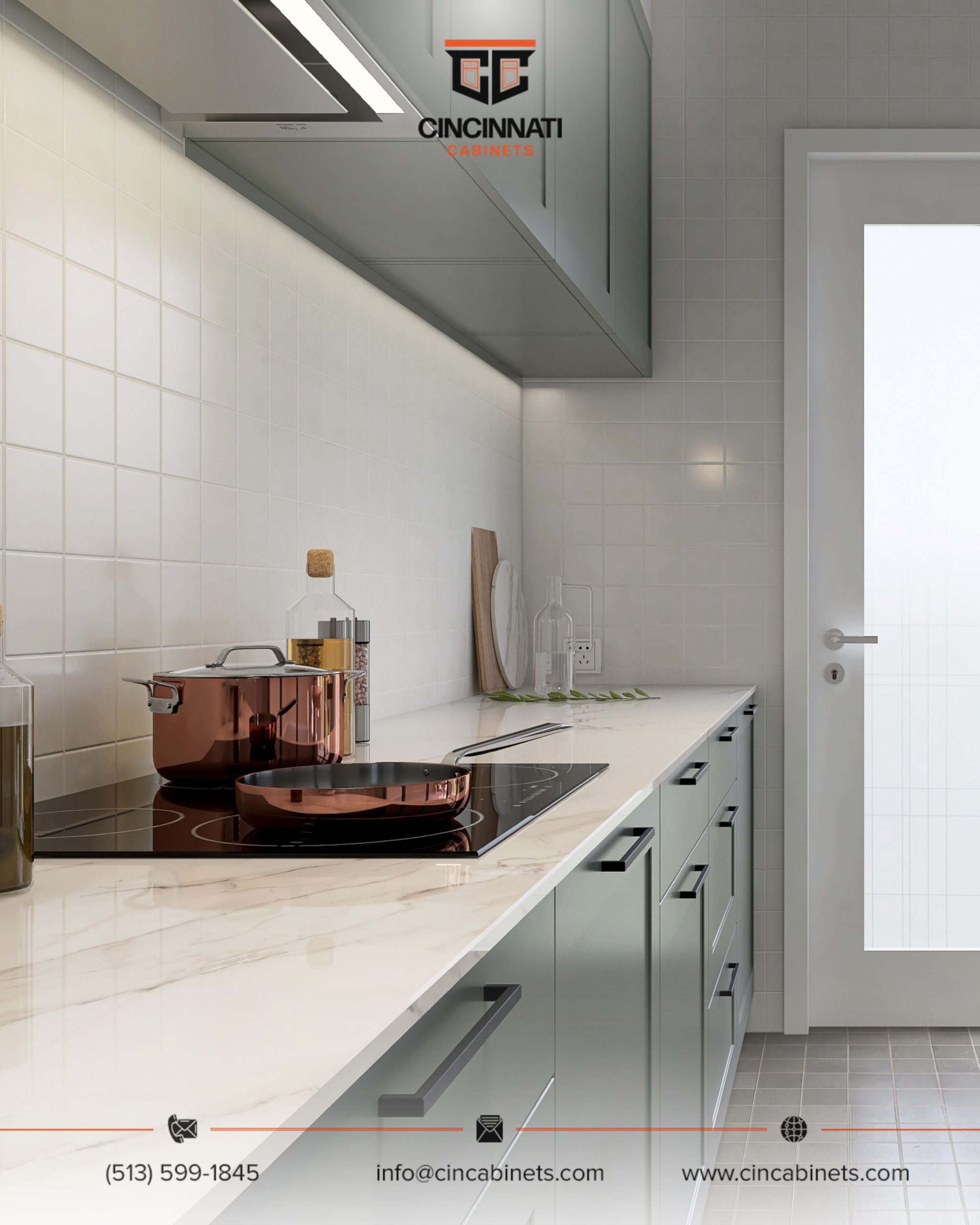
Yes, natural wood and painted cabinets can work beautifully together without making a kitchen look busy. The key is limiting the number of finishes, maintaining consistent cabinet proportions, and choosing colors that complement the wood’s undertones.
At Cincinnati Cabinets, we recommend treating one finish as the foundation and the other as an accent. For homeowners working with cabinet installers in Amelia, OH, this approach creates contrast without making the kitchen feel divided into unrelated sections.
A balanced combination can also make standard kitchen layouts look more intentional and personalized.

What Is the Best Way to Combine Wood and Painted Cabinets?
The simplest approach is to use painted cabinets around the perimeter and natural wood on the kitchen island. This creates a clear focal point while keeping the larger cabinetry surfaces visually consistent.
For example, warm white perimeter cabinets paired with a natural birch island create a soft contrast. The painted cabinets brighten the room, while the wood introduces texture.
We generally avoid alternating wood and painted finishes randomly between individual cabinet doors. Grouping finishes into distinct areas produces a more organized appearance.
Which Wood and Paint Color Combinations Work Best?
The most successful combinations share compatible undertones. Warm woods usually coordinate naturally with cream, beige, and warm white, while cooler wood finishes can work with soft gray or muted blue.
| Wood finish | Painted cabinet color | Overall appearance |
|---|---|---|
| Natural birch | Warm white | Bright and welcoming |
| Light oak | Sage green | Soft and organic |
| Medium walnut | Cream | Warm and sophisticated |
| White oak | Light gray | Modern and understated |
| Dark walnut | Off-white | Strong but balanced contrast |
We recommend comparing samples under natural daylight and kitchen lighting. A paint color that looks neutral in a showroom may appear yellow or blue beside a particular wood finish.
When choosing cabinet installers in Amelia, OH, homeowners should also discuss how the selected wood species will look after staining and finishing.
Should the Kitchen Island Be Wood or Painted?
A natural wood island is often an effective choice because it creates contrast without overwhelming the room. However, a painted island can work equally well when the surrounding cabinets are wood.
The decision depends on the size of the kitchen and which surface should attract attention.
In smaller kitchens, we often prefer lighter perimeter cabinetry because it keeps the walls visually open. A wood island then adds warmth at the center.
For larger kitchens, natural wood perimeter cabinets with a contrasting painted island can create a more traditional, furniture-inspired appearance.
Can You Mix Different Cabinet Door Styles?
Yes, but the door profiles should have a clear relationship. Combining natural wood flat-panel cabinets with painted Shaker doors can work when the overall design remains simple.
However, mixing highly decorative raised panels with minimalist slab doors may create competing styles.
We recommend maintaining consistent door heights, hardware finishes, and cabinet alignment.
For homeowners comparing cabinet installers in Amelia, OH, these construction details are just as important as the colors themselves.
A kitchen with two finishes and consistent proportions often looks more cohesive than a single-color kitchen with poorly aligned cabinetry.
Which Cabinet Materials Work Best for a Two-Tone Kitchen?
Birch and plywood are practical materials for creating durable cabinets with different finishes.
Birch offers attractive natural grain for stained doors and visible panels. Plywood is commonly used for cabinet boxes because its layered construction provides dimensional stability.
Properly finished MDF can also be suitable for certain painted door panels.
| Material | Best application | Durability | Maintenance |
|---|---|---|---|
| Birch | Natural wood doors and panels | Durable hardwood | Maintain protective finish |
| Plywood | Cabinet boxes and shelves | Strong layered construction | Protect edges from moisture |
| Finished MDF | Selected painted doors | Smooth painted surface | Avoid prolonged water exposure |
At Cincinnati Cabinets, we evaluate the intended finish before selecting cabinet materials. Natural wood requires attention to grain consistency, while painted surfaces benefit from smooth, properly prepared substrates.

How Do Countertops Affect the Balance Between Wood and Painted Cabinets?
Countertops connect the different cabinet finishes and help the kitchen feel like one coordinated space.
A light quartz countertop can visually connect white perimeter cabinets with a natural wood island. Granite introduces natural movement, while marble offers distinctive veining.
| Countertop | Appearance | Heat resistance | Stain resistance |
|---|---|---|---|
| Granite | Natural mineral patterns | Generally good | Some varieties require sealing |
| Quartz | Consistent or marble-inspired patterns | Excessive heat can damage resin | Nonporous; generally stain-resistant |
| Marble | Natural veining | Naturally heat-resistant | Can stain and acid-etch |
We recommend avoiding excessive pattern competition.
If the wood has strong grain and the countertop features dramatic veining, a simple backsplash may be the best choice.
Should the Backsplash Match the Painted Cabinets?
Not necessarily, but it should connect the main colors in the kitchen. A backsplash with a neutral tone can prevent wood grain, cabinet paint, and countertop patterns from competing.
For example, cream subway tile can complement natural birch and warm white cabinetry.
A matching quartz backsplash can create a more continuous appearance in contemporary kitchens.
We recommend selecting the backsplash after confirming the cabinet and countertop samples.
What Hardware Looks Best With Mixed Cabinet Finishes?
Consistent hardware usually creates the cleanest result. Brushed nickel, matte black, and warm brass can all coordinate with wood and painted cabinetry.
The best choice depends on the wood’s undertone and the surrounding appliances.
For instance, warm brass can complement natural birch and cream cabinets. Matte black can provide contrast against both light wood and white paint.
We generally recommend using one primary hardware finish throughout the kitchen.
How Much Do Mixed-Finish Kitchen Cabinets Cost?
Our cabinetry starts at $300 per linear foot. The final cost depends on cabinet dimensions, materials, door construction, finishes, and installation requirements.
| Cabinet length | Starting cabinetry calculation |
|---|---|
| 10 linear feet | $3,000 |
| 15 linear feet | $4,500 |
| 20 linear feet | $6,000 |
| 25 linear feet | $7,500 |
These figures represent starting cabinetry costs, not complete installed project prices.
Specialty finishes, countertops, backsplashes, hardware, delivery, and installation may increase the total.
At Cincinnati Cabinets, we recommend comparing the complete project rather than assuming a two-tone design automatically costs more.
For homeowners researching cabinet installers in Amelia, OH, the number of custom components and finish requirements often matters more than simply using two colors.
How Long Does a Two-Tone Cabinet Project Take?
Our typical cabinetry timeline is approximately 3-5 weeks, depending on materials, fabrication requirements, customization, and installation scheduling.
Two-tone projects require careful coordination because both finishes must be approved before fabrication.
Our process generally includes:
- Review the kitchen layout and existing conditions.
- Choose the primary and accent cabinet finishes.
- Select birch, plywood, and appropriate door materials.
- Confirm hardware, countertops, and backsplash combinations.
- Coordinate fabrication and installation.
- Adjust cabinet doors, panels, and finishing details.
We recommend reviewing physical samples before approving the final design.
What Mistakes Make Two-Tone Kitchens Look Too Busy?
The biggest mistake is introducing too many competing finishes. Multiple wood stains, several paint colors, patterned countertops, and decorative backsplashes can overwhelm the space.
We recommend limiting the design to two main cabinet finishes.
Other important considerations include consistent hardware, coordinated undertones, and balanced proportions.
A wood island should feel like part of the kitchen rather than an unrelated piece of furniture.

Frequently Asked Questions About Mixing Cabinet Finishes
Can You Mix Wood and White Kitchen Cabinets?
Yes. Natural wood and white cabinets create a balanced combination when their undertones and proportions coordinate.
Is a Two-Tone Kitchen Still in Style?
Two-tone cabinetry remains a practical design approach because it adds contrast and allows homeowners to combine different materials.
Should Upper Cabinets Be Lighter Than Lower Cabinets?
Often, lighter upper cabinets create a more open appearance, but the best arrangement depends on room size and lighting.
Can You Mix Birch and Painted Cabinets?
Yes. Birch works well as a natural wood accent alongside painted cabinetry.
Does a Two-Tone Kitchen Cost More?
Not necessarily. Costs depend on materials, finish complexity, hardware, and installation requirements.
What Countertop Works Best With Two-Tone Cabinets?
Quartz, granite, and marble can all work. We recommend choosing a countertop that complements both cabinet finishes.
How Long Does Cabinet Installation Take?
Our typical cabinetry project timeline is 3-5 weeks, depending on fabrication, materials, and scheduling.
Where Can You Find Two-Tone Kitchen Cabinet Installation Near Amelia, OH?
Cincinnati Cabinets serves homeowners throughout Cincinnati, OH, including Amelia, OH, and surrounding communities.
We help customers plan cabinet layouts, select birch and plywood construction, coordinate fabrication and installation, and match cabinetry with granite, quartz, marble, and backsplash materials.
If you are comparing cabinet installers in Amelia, OH, we can help you create a balanced kitchen that combines natural wood with painted cabinetry without unnecessary visual clutter.